

Propane Gas
Propane Gas Services in Prince George, BC
Elevated HVAC & Gasfitting is a certified gas contractor serving Prince George and the BC interior with complete propane gas services. Whether you depend on propane for home heating, water heating, appliances, or specialty equipment—or you're ready to convert to mains natural gas—our 15+ years of experience and journeyman expertise ensure safe, code-compliant installations and repairs. As Technical Safety BC registered contractors and FortisBC Trade Allies, we understand BC regulations inside and out and manage every permit and inspection so you can focus on your home.
Why Choose Us
Why Choose Elevated for Propane Gas Work
Certified Gas Contractor expertise
We’re licensed to install, modify, service, and repair propane systems under BC law. Our certification means we understand tank regulations, regulator maintenance, line pressure standards, and the specialized knowledge needed to keep propane systems safe. No subcontractors, no guessing—direct accountability for every connection and repair.
15+ years of hands-on experience
Our team has installed and serviced propane systems in residential homes, renovation projects, and specialty applications across the BC interior. We’ve handled tank replacements, propane-to-natural-gas conversions, appliance connections, and seasonal maintenance. That depth of experience means we diagnose issues accurately and solve problems efficiently.
Family-owned and locally invested
Since 2021, we’ve built our reputation serving Prince George and the surrounding communities. We live here, our families depend on the same services we provide, and our name is on every job. That personal stake in quality means every installation and repair meets our own home standards.
Technical Safety BC & FortisBC credentials
We’re registered with Technical Safety BC and members of the FortisBC Trade Ally Network. We know the regulations that govern propane work in the province, handle all permit applications, and coordinate with inspection authorities so your system passes every check.
Transparent diagnostics & honest advice
We inspect propane systems thoroughly, explain what we find in plain language, and recommend only the work your system actually needs. Whether that’s a regulator cleaning, a tank replacement, or a full conversion to natural gas, you’ll understand your options and the reasoning behind our recommendations.
Journeyman sheet metal expertise
Our team includes a Journeyman Sheet Metal Worker with deep knowledge of venting, ductwork, and ventilation systems. For propane appliances like furnaces and water heaters, proper venting is critical to safety—and that expertise is built into every job we do.

Request Service
Propane Service for Rural and In-Town Properties
Many homes, rural properties, and commercial operations across the BC interior depend on propane for heating, hot water, cooking, and specialty equipment. Propane is efficient, reliable, and flexible—but it requires careful handling, regular maintenance, and expert service to remain safe. Tank placement, pressure settings, connections, and venting all fall under Technical Safety BC standards, and a certified contractor must handle any work that affects system safety. Whether you're installing, maintaining, converting to natural gas, or repairing a leak or regulator issue, we'll guide you through the entire process with expert knowledge and full code compliance.
Request Your Service
Our Process
How Propane Systems Operate and Why Regular Service Matters
1. Tank Placement & Regulator Setup
Your propane tank is placed outside on a concrete pad, buried underground, or mounted on a structure depending on system design and local codes. BC regulations specify minimum distances from buildings, property lines, and sources of ignition—we ensure every installation meets these requirements and your tank placement is both safe and accessible for regular service. A regulator attached to the tank reduces utility-line pressure (often 100+ PSI) down to the safe, low pressure your appliances need to function—usually under 15 PSI for residential use. That regulator experiences temperature swings, moisture from humidity, operational stress, and seasonal freeze-thaw cycles in BC weather. It’s the most critical component of your system and the first place we inspect during maintenance.
-
Place the tank per BC code minimum distances from buildings, property lines, and ignition sources -
Match tank size and placement (above-ground or buried) to your heating demand -
Install and set the regulator to reduce line pressure to safe appliance levels -
Inspect the regulator for temperature, moisture, and freeze-thaw stress -
Catch regulator wear before it affects heating or hot water flow -
Ensure tank placement remains accessible for regular service
2. Lines Carry Gas Into Your Home
From the tank through a service line to your home, propane travels in copper tubing or steel pipe. Each line must be properly sized for the total BTU demand of all appliances it serves—undersized lines create pressure drop and weak appliance performance; oversized lines waste material and money. Lines must also slope correctly toward a drain point so condensation and moisture don’t accumulate inside. Moisture inside propane lines is an insidious problem: it can freeze at regulators or shutoff valves in winter, blocking gas flow entirely. We design lines to industry standards, install drain points where needed, and use proper pipe materials rated for propane.
-
Size each line for the total BTU demand of the appliances it serves -
Slope lines toward a drain point to prevent moisture accumulation -
Use copper tubing or steel pipe rated for propane service -
Install drain points where needed to clear condensation -
Prevent moisture from freezing at regulators and shutoff valves in winter -
Run winterization checks before each heating season to confirm reliable operation
3. Each Appliance Gets a Regulated Connection
Every appliance—furnaces, water heaters, ranges, fireplaces, dryers, pool heaters, outdoor grills—connects to the main propane line via an individual shutoff valve and regulator or pressure-reducing device. Each connection must be airtight (using proper fittings, no threads sealing with plumber’s tape), properly vented where required (to expel combustion gases and moisture safely outdoors), and tested for leaks before the appliance is used. A loose or corroded fitting is a hazard; moisture or sediment inside connections can block flow or cause regulator failure. We inspect every connection during maintenance using industry-standard leak detection equipment, replace worn components before they fail, and re-test the entire system to confirm safety.
-
Connect each appliance with an individual shutoff valve and regulator -
Make every connection airtight with proper fittings -
Vent appliance connections to expel combustion gases and moisture outdoors -
Test every connection for leaks before the appliance is used -
Inspect connections during maintenance with leak detection equipment -
Replace worn components before they fail and re-test the entire system
4. Annual Inspection Prevents Problems
Professional annual inspection—ideally before the heating season when you’ll rely most heavily on your propane system—catches leaks, checks regulator function, verifies proper venting on all appliances, inspects tank and line condition for corrosion or damage, and tests pressure stability under load. We also clean inlet screens and check for corrosion on tank exterior and connections. This routine care prevents catastrophic system failures during heavy winter heating demand and keeps your propane system operating safely, efficiently, and reliably. Many homeowners discover they’ve had a small leak or regulator issue only when an appliance starts performing poorly—early discovery during scheduled maintenance prevents both the inconvenience of a failure and the cost of emergency repairs.
-
Inspect before the heating season, when demand is highest -
Check for leaks and verify regulator function -
Confirm proper venting on all appliances -
Inspect tank and line condition for corrosion or damage -
Test pressure stability under load -
Clean inlet screens and check for corrosion on the tank exterior and connections
5. Prompt Repair Restores Safety & Reliability
If you notice weak appliance performance, intermittent heating or hot water, a strong propane smell, hissing sounds at the regulator or tank, or suspect a leak, we diagnose and repair the problem quickly. We use professional electronic leak detection equipment that can find even tiny leaks; pressure-test the system after repairs to confirm safety; and verify every appliance is operating at proper pressure and temperature before you rely on it again. Whether it’s a regulator issue, a furnace repair, a water heater connection problem, or a frozen line in winter, certified expertise prevents small issues from becoming safety hazards or costly replacements.
-
Diagnose weak appliance performance and intermittent heating or hot water -
Investigate propane smell or hissing at the regulator or tank -
Use professional electronic leak detection to find even tiny leaks -
Pressure-test the system after repairs to confirm safety -
Verify every appliance operates at proper pressure and temperature -
Address regulator issues, appliance connections, and frozen lines in winter




Propane Answers
What to Know About Propane in British Columbia
Propane is a liquefied petroleum gas stored in tanks; natural gas is delivered through utility mains. Propane is more energy-dense, useful for remote properties without utility access. Both are safe when properly installed and maintained. Many customers eventually switch from propane to natural gas when utility service becomes available, especially for lower operating costs and reduced tank management.
At least once annually, preferably before the heating season when demand is highest. We recommend inspection after any repairs, any time you smell propane or notice appliance problems, and if your tank hasn't been serviced in over a year. Seasonal winterization checks also prevent frozen regulators and blocked lines in cold weather.
Do not investigate or try to locate the smell yourself. If the smell is strong, leave your home immediately and call Fortis BC's gas emergency line from outside (never from inside where a phone might spark). If the smell is faint, turn off the propane supply at the tank if you can do so safely, leave the area, and contact us for inspection. Never ignore a propane smell—it's your system's warning signal.
Pressure testing uses nitrogen gas (never air or oxygen, which create fire hazards) pressurized into lines and connections. We measure if pressure holds steady over time—any drop indicates a leak. We locate the leak, repair it, and re-test until the system holds pressure safely. This test confirms your system is leak-free before you use it.
Yes. We manage complete propane-to-natural gas conversions. This involves running a new gas line from FortisBC's service point to your home, modifying or replacing appliances as needed, and scheduling Technical Safety BC inspections. Many customers save money and gain convenience switching to natural gas. We handle all permits and code compliance throughout the process.
Tank placement must follow BC codes for safety distance from buildings, property lines, and structures. Tank size, above-ground or buried placement, and regulator type all depend on your heating demand and property layout. We assess your property, recommend the best placement, handle all permits, and ensure proper installation so your tank is both safe and accessible for service.
Regulators can accumulate moisture and sediment, especially in humid or cold climates. Annual cleaning and inspection keep the regulator functioning reliably. If you notice weak gas flow, pressure fluctuations, or hissing at the regulator, we can clean, adjust, or replace it depending on the problem. Proper regulator service prevents appliance performance issues and maintains system safety.
Propane has higher per-unit energy cost than natural gas but is often the only option for properties without utility access. Operating costs depend on tank size, appliance efficiency, and heating demand. We provide upfront estimates and can discuss whether switching to natural gas (if service becomes available) makes financial sense for your situation.
Leaks occur at loose fittings, corroded connections, or damaged lines. We use professional electronic leak detection equipment to locate even tiny leaks. Once found, we repair the source and pressure-test the system to confirm the leak is sealed. Prevention is key—regular inspection and tight connections caught during maintenance prevent most leak problems.
Annual inspections, regulator cleaning, connection checks, and seasonal winterization prevent leaks, appliance failures, and costly emergency repairs—far more economical than paying for emergency calls.
Related Work
Equipment Your Propane System Feeds
Gas Line Installation & Replacement
New propane lines, tank placement and setup, conversions from propane to natural gas, and system expansions when you add appliances or renovate.
Gas Line Repair & Service
Leak detection and repair, regulator maintenance and replacement, pressure testing, connection issues, and seasonal winterization to prevent cold-weather problems.
Pressure Testing
Verify tank, regulator, and line pressure to confirm your system is holding steady and delivering gas safely.
Leak Detection & Inspection
Dedicated electronic leak-finding for propane lines, fittings, and appliance connections.
Gas Safety Checks
Annual inspections that catch regulator wear, corrosion, and venting issues before they become emergencies.
Appliance Connections
Water heaters, kitchen stoves, fireplaces, dryers, and specialty equipment all require precise, code-compliant propane connections with proper venting.
Furnace Repair & Installation
Many propane-heated homes rely on furnaces for primary heating. We design, install, maintain, and repair propane furnaces with expert attention to safe gas connections and proper venting.
Service Areas
Propane Service Throughout the Region
We proudly serve Prince George and the following surrounding communities with expert propane gas installation, repair, and inspection services.
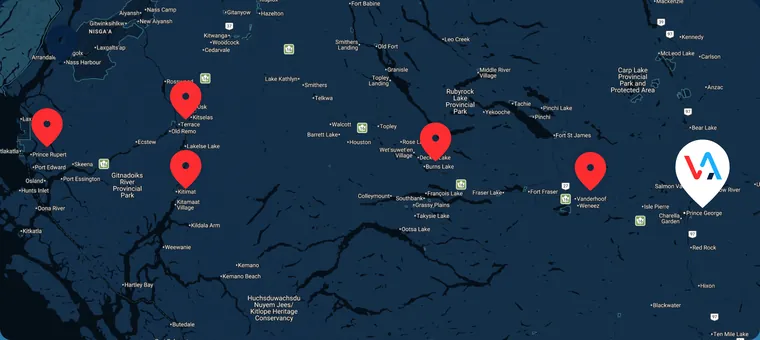
Additional Communities Served
Don't see your community listed? Reach out and we'll let you know if we can get to you.
Prince George
Our home base. Comprehensive propane system installation, tank placement, regulator service, and repair for homes and businesses throughout the city and surrounding neighborhoods.
Terrace, BC
Coastal northwest region. We handle propane installations, conversions to natural gas, and safety inspections for properties across the area.
Prince Rupert, BC
Northwest coastal community. Complete propane services from tank placement to regulator repair, all performed to full Technical Safety BC compliance.
Kitimat, BC
Mountainous terrain with unique infrastructure considerations. Our expertise handles challenging site conditions for tank placement and line routing.
Burns Lake, BC
Highway 16 corridor between Prince George and the coast. Full propane installation, repair, and maintenance services from our central operations base.
Vanderhoof, BC
Central interior community with strong heating demands. We provide propane installation, repair, and regulator service with reliable, code-compliant workmanship.

Specials & Coupons
Giving back to the community
We're proud to offer discounts to the people who serve our community.
First Responder & Senior Discount
A discount on service for active first responders and seniors.
Cannot be combined with any other offer.
Schedule Service
Customer Reviews
Read ReviewsSee What Our Prince George Neighbors Are Saying
We've built our reputation one job at a time across Prince George and the surrounding Northern BC communities. Read what real customers have to say about working with our team, and check out our current rating on Google.
Talk to Us
Propane Expertise You Can Rely On
Propane powers homes across Prince George, Terrace, Prince Rupert, Kitimat, Burns Lake, and Vanderhoof—and your system deserves expert care from someone who knows BC codes and propane regulations inside and out. From tank placement and new line installation to annual safety inspections, repairs, and propane-to-natural-gas conversions, Elevated HVAC & Gasfitting brings certified expertise and a commitment to your family’s safety. We’re registered with Technical Safety BC and members of the FortisBC Trade Ally Network, meaning we understand every regulation and best practice that governs propane work in this region. Our 15+ years of hands-on experience and Certified Gas Contractor credential give you confidence that every job is done correctly—the first time.
Whether you’re installing a new propane system for new construction, expanding service to support additional appliances, maintaining existing equipment to prevent mid-winter heating failures, converting from tank propane to mains natural gas for lower operating costs, or addressing a leak or regulator issue, we’re here to help. We handle all permits, coordinate with inspection authorities, and manage every technical detail so your propane system operates safely and reliably throughout BC’s challenging seasons. Our upfront quotes explain all options and costs; we discuss trade-offs and help you choose the solution that matches your needs and budget.
Larger projects qualify for flexible financing through FinanceIt, spreading the cost over manageable monthly payments so cost never becomes a barrier to a safe, efficient system. And annual inspections keep your propane system running dependably—far more economical than paying premium rates when a system fails in the coldest months.
Family-Owned & Operated
Fortis BC Trade Ally Network
Journeyman Sheet Metal Worker
Certified Gas Contractor
15+ Years of Experience
Satisfaction guaranteed
