

Permits, Codes & Compliance
Gas Permits & Technical Safety BC Compliance in Prince George
Gas system work in British Columbia is governed by Technical Safety BC and provincial gas codes. Permits aren't just bureaucracy—they're the mechanism that ensures your gas system is safe, properly inspected, and compliant with current standards. Whether you're installing a new gas line, modifying an existing system, or upgrading appliance connections, permit requirements vary by scope and location. Elevated HVAC & Gasfitting is a Technical Safety BC registered contractor with expertise in navigating BC gas codes, applying for required permits, managing inspections, and bringing aging or non-compliant systems into code. We handle the regulatory side so you never wonder if your gas system will pass inspection.
Why It Matters
Why Partner With Us for Gas Compliance
Technical Safety BC Registered & In Good Standing
We are a registered gas contractor with Technical Safety BC, the provincial authority that governs gas safety, permits, and inspections across BC. Being registered means our work is audited, our practices meet or exceed code, and homeowners can be confident in both the quality and the regulatory standing of every installation, repair, and modification we perform. Our registration is a mark of accountability.
Deep Knowledge of BC Gas Codes & Permit Requirements
Gas codes change, and exemption thresholds vary by project scope. Some modifications need a permit and inspection; others are exempt if they meet specific criteria. Many homeowners and even some contractors don’t fully understand when a permit is required. We know. We track BC Code updates, understand the scope thresholds, and know exactly when you need to apply for a permit and when work can proceed without one. This saves you money by avoiding unnecessary permits while keeping you safe and legal.
Complete Permit Application & Document Management
We prepare and submit permit applications to Technical Safety BC on your behalf. We manage timelines, respond to inspector requests, and coordinate inspection scheduling. Once work is approved and inspected, we handle all final documentation. You never have to navigate the government portal or worry about missing a deadline—we own the process.
In-Depth Pre-Work Assessment for Code Compliance
Before any work begins, we evaluate your current system against BC Code requirements. Is your existing gas line the right size for new appliances you’re installing? Are your appliance connections compliant with current standards? Is your meter installation code-legal? Are regulators positioned correctly? We identify non-compliant conditions upfront, explain the issue, and plan work that brings everything into code in a single project.
Experience Managing Failed Inspections & Corrections
Sometimes an inspector identifies an issue during inspection, and the work doesn’t pass the first time. This happens for many reasons—a measurement is outside tolerance, a fitting isn’t the right type, or something in the installation doesn’t match the technical specification. We know how to read inspector feedback, understand what correction is needed, execute the fix, and resubmit for inspection. We’ve done this hundreds of times; we know how inspectors think and what they’re looking for.
15+ Years of Navigating Regulatory Changes & Scope
Gas codes have been updated multiple times over our years in business. We’ve managed transitions, learned new standards, and adapted our practices accordingly. We also understand the nuances: when work is tied to other trades (HVAC ducts, electrical upgrades), how to coordinate inspections, and how to avoid conflicts between gas code and other building disciplines.

Next Step
Permits, Inspections & Compliance Made Simple
Gas system work in BC requires navigating Technical Safety BC's permit and inspection system. If your work scope requires a permit, applying correctly and passing inspection the first time protects your property value, ensures your insurance will honor claims, and gives you peace of mind that your system is safe and legal.
The challenge for many homeowners: it's not always obvious whether a permit is required. A small appliance connection might be exempt. A new furnace installation definitely requires a permit. A gas line extension to a pool heater? Probably. The threshold depends on several factors—scope, location, type of modification—and getting it wrong can mean rework, failed inspections, or even liability if something goes wrong later. Our job is to know those thresholds and help you comply without unnecessary steps.
Request Your Assessment
Our Process
Our Permit & Compliance Process
1. Scope Assessment & Code Review
When you contact us with a gas project—whether it’s a new appliance connection, a line extension, a system modification, or a full replacement—we first understand your intent. What are you trying to accomplish? What work is involved? Once we understand scope, we review BC Code requirements and determine whether a permit is necessary. Some modifications are exempt; others require a formal application. We’ll tell you which category your work falls into and explain the reason.
-
Understand your project intent and what you’re trying to accomplish -
Determine the full scope of work involved -
Review BC Code requirements against that scope -
Establish whether a permit is required or the work is exempt -
Explain the reason for the determination clearly
2. Site Inspection & Existing System Evaluation
We visit your property and inspect your existing gas system: meter installation, line routing, regulator type and position, appliance connections, shutoff valves, venting (for enclosed appliances), and overall condition. We assess the system against current code standards and identify any non-compliant conditions. If code-correction work is needed before your planned modifications, we flag it and include it in the scope.
-
Inspect meter installation, line routing, and regulator type and position -
Check appliance connections, shutoff valves, and venting for enclosed appliances -
Assess overall system condition against current code standards -
Identify any non-compliant conditions present today -
Flag code-correction work needed before planned modifications -
Include necessary corrections in the project scope
3. Design & Sizing Specification
If your project involves new gas lines, appliance connections, or system expansion, we design the work to code: correct pipe sizing based on gas demand, proper regulator pressure settings, venting requirements, and fitting specifications. For water heaters, furnaces, and other appliances, we confirm the gas supply is adequate and properly configured. We also assess interaction with other building systems—HVAC ductwork, electrical wiring, structural elements—to ensure no conflicts arise during installation.
-
Size pipe correctly based on total gas demand -
Set proper regulator pressure settings for the system -
Specify venting requirements and fitting specifications -
Confirm gas supply is adequate for water heaters, furnaces, and other appliances -
Assess interaction with HVAC ductwork, electrical wiring, and structural elements -
Design to avoid conflicts arising during installation
4. Permit Application Preparation & Submission
If a permit is required, we prepare the application package: engineering drawings, system specifications, project description, and any supporting documentation Technical Safety BC requests. We submit the application on your behalf and manage the approval timeline. Most permit approvals take 2–5 business days; complex projects may take longer. We’ll keep you updated on status.
-
Prepare engineering drawings and system specifications -
Write the project description and gather supporting documentation -
Submit the application to Technical Safety BC on your behalf -
Manage the approval timeline (typically 2–5 business days) -
Keep you updated on application status throughout
5. Work Execution to Specification
Once the permit is issued (or confirmed as exempt), we execute the work exactly as designed. Every fitting, pipe size, regulator setting, and connection point follows the specification and code. We photograph work during installation so documentation exists for the inspection. We also coordinate with any other trades involved—HVAC installers, electricians, plumbers—to ensure gas work doesn’t interfere with their systems and vice versa.
-
Execute every fitting, pipe size, and connection point to specification -
Set regulators precisely per the design and code -
Photograph work during installation for inspection documentation -
Coordinate with HVAC installers, electricians, and plumbers -
Ensure gas work does not interfere with other building systems
6. Pre-Inspection Walkthrough & Final Verification
Before calling for an official inspection, we run our own verification: we test gas pressure, confirm all connections are tight, verify venting is proper (for appliances that require it), and check that all code requirements are met. We’re looking for anything an inspector might catch and fixing it ourselves. This reduces the chance of a failed inspection and keeps your project on schedule.
-
Test gas pressure across the system -
Confirm all connections are tight and secure -
Verify venting is proper for appliances that require it -
Check that all code requirements are met -
Identify and fix anything an inspector might catch -
Reduce the chance of a failed inspection and keep the project on schedule
7. Technical Safety BC Inspection & Approval
An assigned Technical Safety BC inspector visits your property and reviews the completed work against the permit specifications and BC Code. They’ll check pipe sizing, connections, regulator function, appliance integration, venting, and documentation. Most inspections pass on the first visit. If the inspector identifies any discrepancies, we understand their feedback, make corrections, and schedule a re-inspection if needed. We own the process and will get your work fully approved.
-
Inspector reviews work against permit specifications and BC Code -
Pipe sizing, connections, and regulator function are checked -
Appliance integration, venting, and documentation are verified -
Most inspections pass on the first visit -
If discrepancies are found, we understand feedback and make corrections -
We schedule re-inspection if needed and get work fully approved
8. Final Documentation & Handoff
Once inspection is passed and approved, Technical Safety BC issues a final inspection certificate. We provide you with a complete package: the inspection certificate, all technical drawings, testing records, warranty information, and a guide to your system. This documentation is essential for insurance, home sales, and future repairs. You’ll have everything you need to prove your system is code-compliant and professionally installed.
-
Technical Safety BC issues a final inspection certificate -
You receive the inspection certificate and all technical drawings -
Testing records and warranty information are included -
A guide to your system is provided -
Documentation supports insurance, home sales, and future repairs -
You can prove your system is code-compliant and professionally installed




Common Questions
Frequently Asked Questions About Gas Permits & Compliance
In most cases, yes. BC Code requires a permit when you're installing a new gas appliance or modifying existing gas lines to serve a new appliance. The permit triggers a Technical Safety BC inspection. Some minor work—like replacing an appliance with an identical model using existing connections—may be exempt. We evaluate each case; when in doubt, applying for a permit is the safe choice.
A permit is the authorization to do the work. You apply to Technical Safety BC, describe the scope, and once approved, you can proceed. An inspection is the verification that the completed work meets code. The inspector visits after work is finished, checks everything against the permit specifications and code, and issues a certificate if all is compliant. Both are necessary for permitted work.
Permit fees vary based on project scope and are set by Technical Safety BC. A simple appliance connection permit costs less than a full gas line installation. We assess your scope, pass through the exact fee, and tell you the cost upfront before we apply—no surprises on your invoice.
From application to inspection approval typically takes 1–2 weeks, depending on Technical Safety BC workload and project complexity. Permit approval usually happens within 2–5 business days. Once the permit is issued, we schedule work. After work is complete, inspection may happen within a few days or a week depending on inspector availability. We manage timelines and keep you informed.
Most work passes inspection because we perform our own pre-inspection verification. If an inspector identifies an issue, we understand the feedback, make the correction, and request a re-inspection. Re-inspections are typically scheduled quickly. This happens occasionally and we never charge additional labour for corrections resulting from code interpretation.
Yes. BC Code includes exemptions for certain minor work: replacing an appliance with an identical model, small isolated repairs, and some maintenance activities don't require permits. However, most gas system modifications—new lines, appliance upgrades, connection changes—do require a permit. We evaluate your work against exemption criteria and advise you accurately.
Non-compliant work doesn't pose immediate danger but may require correction before new work is approved. When you apply for a permit on new work, an inspector may flag existing non-compliant conditions and require correction as part of the new project. We'll assess what's non-compliant, explain why, and bundle corrections into the project scope.
Many insurance policies require that work meet local code and have been inspected by the appropriate authority. If gas work was done without a permit and something goes wrong, your insurer may deny the claim because the work wasn't officially approved. Permitted, inspected work protects your claim coverage and your family's safety.
The inspector will review the completed gas work and check pipe sizing, connections, regulator function, appliance integration, venting for appliances that require it, pressure testing, and documentation. They'll verify everything matches the permit specifications and meets BC Code. Most inspections take 30 minutes to a couple of hours. We'll be present to show the work and answer questions.
British Columbia law restricts gas work to licensed contractors. Only a Certified Gas Contractor can legally perform gas line installation, repair, and modification. Unlicensed work is illegal, uninsurable, and creates serious safety liability. Always hire a licensed contractor. It's safer, cheaper in the long run, and protects your home's value.
Related Services
Related Gas & HVAC Services
Gas Line Installation & Replacement
Design and installation of new gas lines with full permit coordination and inspection management.
Appliance Connections
New gas appliance hookups, assessed for permit requirements and built to code specifications.
Gas Line Repair & Service
Diagnostics and repair of gas system failures, with assessment of compliance implications.
Safety Checks
Inspections to identify aging, non-compliant, or unsafe conditions before they become problems.
Natural Gas Line Services
New natural gas installations and system upgrades, all assessed for permit requirements.
Propane Gas Services
Tank placement, conversions, and propane line work, coordinated with Technical Safety BC standards.
Pressure Testing
Required verification testing before any new or modified gas line is put into service.
Service Areas
Gas Permit & Compliance Services Across Northern British Columbia
We proudly serve Prince George and surrounding BC communities with full gas permit management, Technical Safety BC coordination, and code compliance expertise—handling every regulatory step wherever you are.
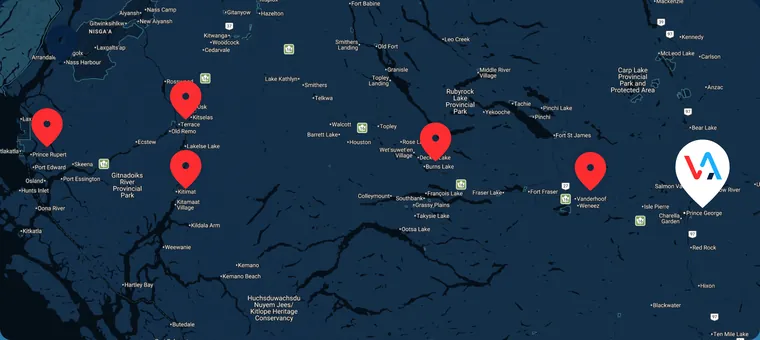
Additional Communities Served
Don't see your community listed? Reach out and we'll let you know if we can get to you.
Prince George, BC
Our home base. We manage gas permits, coordinate Technical Safety BC inspections, and ensure all gas installations and modifications in Prince George meet current BC Code standards.
Terrace, BC
Northwest coastal region. We handle permit applications, inspections, and compliance work for residential and commercial gas systems serving the Terrace area and surrounding communities.
Prince Rupert, BC
Coastal community. We manage gas permits and Technical Safety BC coordination for properties throughout Prince Rupert, ensuring compliance with provincial standards.
Kitimat, BC
Mountain terrain with varied home ages and construction. We provide full permit management and compliance assessment for gas system work across Kitimat.
Burns Lake, BC
Highway 16 corridor. We coordinate Technical Safety BC permits, inspections, and compliance work for residential and light commercial gas systems.
Vanderhoof, BC
Central interior community. Complete gas permit management and code compliance assessment for properties throughout Vanderhoof.

Specials & Coupons
Giving back to the community
We're proud to offer discounts to the people who serve our community.
First Responder & Senior Discount
A discount on service for active first responders and seniors.
Cannot be combined with any other offer.
Schedule Service
Customer Reviews
Read ReviewsSee What Our Prince George Neighbors Are Saying
We've built our reputation one job at a time across Prince George and the surrounding Northern BC communities. Read what real customers have to say about working with our team, and check out our current rating on Google.
Ready When You Are
Keep Your Gas System Compliant & Code-Legal
Gas system compliance isn’t just about passing an inspection—it’s about protecting your property value, ensuring insurance coverage, and keeping your family safe. Whether you’re planning a gas line modification, installing a new appliance, upgrading an aging system, or addressing a code violation identified during a home inspection, working with a Technical Safety BC registered contractor ensures the work is done right and officially approved.
Elevated HVAC & Gasfitting manages the entire permit and inspection process for you. We assess your project against BC Code, prepare the permit application, execute the work to specification, and coordinate the Technical Safety BC inspection. You’ll have complete documentation and the confidence that your gas system is safe, legal, and compliant. We’re familiar with Technical Safety BC’s processes, understand current BC Code requirements, and have managed hundreds of inspections. We know how inspectors evaluate work and what they’re looking for.
Elevated HVAC & Gasfitting is locally owned and operated. Most importantly, we take the regulatory burden off your shoulders so you can focus on the project itself. Call us today to discuss your gas project, get clarity on permit requirements, and schedule your compliance assessment.
Family-Owned & Operated
Fortis BC Trade Ally Network
Journeyman Sheet Metal Worker
Certified Gas Contractor
15+ Years of Experience
Satisfaction guaranteed
