

Diagnostic Precision Testing
Gas Line Pressure Testing & Diagnostics in Prince George, BC
Your gas system's pressure is its lifeline. Without proper pressure, appliances won't ignite, won't run, or run inefficiently. Too high, and the system risks damage and leaks. Elevated HVAC & Gasfitting uses precision pressure gauges, certified procedures, and Technical Safety BC protocols to measure your system's health at every critical point—at the meter, along the main line, and at each appliance inlet. In minutes, we know whether your gas delivery is sound or whether a regulator failure, a blockage, or a leak is compromising system performance.
Why It Matters
Why Pressure Testing Is Your System's Health Check
Precision diagnostics that point to the real problem
Many gas symptoms look the same: a pilot light won’t light, a burner won’t ignite, a furnace shuts down. But the cause could be a regulator failure, a partially blocked line, a leak, or even an appliance fault. Pressure testing separates those causes in minutes. A reading that’s low tells us the supply system is failing. A reading that drops over time means gas is escaping. A reading that’s normal but the appliance still fails points to an appliance defect, not your gas line. We deliver diagnostic clarity with every test.
Verify code compliance on new installations
Every gas line installation must be pressure-tested per Technical Safety BC code before it’s put into service. We pressure-test new piping to confirm it holds steady, seals are tight, and the system is ready for use. Without test documentation, a home inspector or insurance company may refuse to approve your installation. Whether you’ve just had a new gas line installed, hired us to run piping to a new appliance, or upgraded your system, we’ll deliver the certified documentation you need. Our testing ensures every joint, fitting, and connection is code-compliant and safe.
Confirm a repair is really fixed
A corroded section was spliced, a regulator was replaced, or a loose fitting was tightened. But did the repair really solve the problem? Pressure testing confirms it. If pressure now holds steady where it was dropping before, you know the leak is gone. If pressure is now in the normal range where it was low before, the supply issue is fixed. Testing removes any doubt—the repair worked.
Catch problems before they become expensive
A slow leak loses gas day after day, inflating your utility bill. A regulator that’s slowly failing will eventually fail completely, leaving you without gas when you need it most. A blockage in the line builds pressure on one side and starves appliances on the other. Pressure testing catches all of these while they’re still diagnosable and fixable. Fixing a regulator for a few hundred dollars today beats an emergency replacement when it fails at minus twenty degrees.
Professional-grade equipment & certified interpretation
We don’t use a basic gauge and hope for the best. We carry precision pressure instruments, know the normal ranges for your appliances, understand how temperature and altitude affect pressure readings, and follow Technical Safety BC protocols. Our test results are documented and defensible—if a building inspector questions your system, our pressure test report proves it was sound.
Transparent reporting
You get a detailed written record: what we tested, the pressures we measured at each point, what the readings mean, and what action (if any) is needed. If pressure is within spec, we’ll tell you the system is sound. If an issue is present, we’ll explain what it is and recommend the next step: a regulator replacement, leak location and repair, or a blockage investigation.

Next Step
When Pressure Testing Gives You the Answers You Need
You don't need to guess what's wrong with your gas system. A single pressure test often answers the questions: Is my system leaking? Is my regulator failing? Is the utility supplying gas at the right pressure? Is my new installation code-compliant? Is my repair really fixed? Call us when you want certainty instead of guessing—whether you're troubleshooting a symptom, verifying a repair, confirming a new installation, or investigating a persistent appliance problem, pressure testing is fast, precise, and affordable.
Request Your Pressure Test
Our Process
Our Pressure Testing & Diagnosis Process
1. Initial Consultation & Test Planning
When you call, tell us what prompted the testing: are you troubleshooting a symptom (pilot light issue, appliance won’t ignite), verifying a new installation, confirming a repair, or conducting a routine safety check? We’ll ask a few quick questions about which appliances are affected and whether you’ve noticed any other changes. This helps us plan the test points and ensure we’re answering the questions that matter to you.
-
Identify what prompted the testing so we test the right questions -
Ask which appliances are affected and what changes you’ve noticed -
Determine whether you need troubleshooting, verification, or a safety check -
Plan the test points based on your system and your concerns -
Explain what we’ll be measuring and why it matters
2. System Access & Test Point Identification
We’ll locate the meter, identify the main supply line, and find the most accessible test points downstream. On a typical installation, we’ll test pressure at the meter (to confirm what the utility is supplying), at the regulator outlet (to verify the regulator is doing its job), and at each appliance inlet (to confirm each device is getting adequate pressure). Older homes or complex piping might need additional test points. We’ll explain what we’re testing and why.
-
Locate the meter and identify the main supply line -
Find the most accessible downstream test points -
Test at the meter to confirm what the utility is supplying -
Test at the regulator outlet to verify it’s doing its job -
Test at each appliance inlet for adequate pressure -
Add extra test points for older homes or complex piping
3. Static Pressure Measurement
With all appliances turned off and the system at rest, we connect a precision pressure gauge to the first test point and record the static (resting) pressure. Normal gas system pressure for residential lines is typically 6–8 inches of water column (0.22–0.31 kiloPascals, or kPa). If the reading is high, low, or erratic, we’ll note it. We understand the nuances that affect readings: temperature variations can shift pressure slightly, altitude affects the calculations (Prince George sits at roughly 2,000 feet elevation, which our gauges account for), and the condition of the meter itself matters.
-
Turn off all appliances so the system reads at rest -
Connect a precision gauge and record static pressure at each point -
Compare against the normal 6–8 inches of water column range -
Note any reading that is high, low, or erratic -
Account for temperature, altitude, and meter condition -
Flag a significant drop between points as a regulator or blockage sign
4. Dynamic Pressure & Load Test
We’ll ask you to turn on one appliance (a burner, the furnace, a fireplace) so we can measure pressure while the system is under load. Dynamic pressure should stay very close to static pressure—a big drop under load signals a supply-side problem. If the dynamic pressure is significantly lower than the static pressure—for example, 5 inches under load when it was 7 inches at rest—this indicates a supply restriction: either the regulator is wearing out and can’t maintain pressure under demand, or there’s a blockage somewhere downstream that limits gas flow.
-
Turn on one appliance to place the system under load -
Measure dynamic pressure and compare it to the static reading -
Test multiple appliances or combinations to understand behavior -
Recognize a large drop under load as a supply-side problem -
Distinguish a worn regulator from a downstream restriction -
Recommend investigation of the regulator or the line when needed
5. Pressure Drop / Leak Test
If a leak is suspected, we’ll turn off all appliances and appliance pilots, seal or cap the meter isolation valve, and watch the pressure gauge over several minutes. If the pressure holds absolutely steady, there’s no leak in the line. If it drops gradually, there’s a leak somewhere downstream. The rate of drop helps us estimate the leak’s size. Over the course of 10–15 minutes, we’ll know whether gas is escaping and roughly how much. Once we’ve confirmed a leak exists, the next step is leak detection with electronic equipment to locate the exact point.
-
Turn off all appliances and pilots and isolate the meter valve -
Watch the gauge over several minutes for any pressure change -
A steady reading confirms there is no leak in the line -
A gradual drop confirms a leak somewhere downstream -
Estimate the leak’s size from the rate of drop -
Confirm appliance-specific pressure needs where devices still fail -
Document every test point, reading, and clear conclusion




Common Questions
Frequently Asked Questions About Gas Pressure Testing
Residential natural gas systems typically operate at 6–8 inches of water column (about 0.22–0.31 kPa). Propane systems run higher—about 10–14 inches of water column. The utility meter regulator is designed to deliver gas at this pressure. If pressure is consistently higher or lower than this range, an appliance won't run correctly. We'll confirm your system's pressure against manufacturer specs for your appliances.
It depends on the cause. If a regulator is failing, replacement is necessary. But low pressure can also result from a partially blocked line (debris, corrosion buildup, or a frozen water trap in very cold conditions), which can sometimes be cleared. Or it could be a leak where gas is escaping. Pressure testing identifies the cause; the fix varies. We'll tell you upfront what the solution is.
A pressure drop indicates a leak somewhere in the system beyond the test point. As time passes, gas escapes and the gauge reading drops. The rate of drop helps us estimate the leak's size—a tiny leak drops just a few tenths of an inch per minute, while a larger leak drops much faster. Once we confirm a leak, we use leak detection equipment to pinpoint its location and repair it.
Yes. Technical Safety BC code requires pressure testing before a new gas line is put into service. We test to confirm every joint, fitting, and connection is sealed properly and the entire system holds pressure without leaking. You'll need this test documentation for a home inspection, permit closeout, or insurance verification. We provide complete documentation.
Most tests take 30–60 minutes depending on the system's size and complexity and how many appliances we're testing. If we discover an issue that needs further diagnosis like finding a leak and then locating it with electronic equipment, we may schedule a separate follow-up appointment.
No. Pressure testing measures the system; it doesn't change it. The gauge is connected at an isolated test point, not inside the appliance, so there's no risk to your furnace, water heater, or stove. Testing is safe and non-invasive.
We'll explain exactly what the failure is—a regulator that isn't holding the right pressure, a leak that's present, or a blockage reducing flow. We'll recommend the repair or follow-up diagnostic needed and provide a quote. Most problems identified through pressure testing are straightforward to fix once you know what's wrong.
Possibly. If testing reveals a slow leak, we'll locate and repair it—stopping the leak immediately saves money. If testing shows low pressure causing an appliance to run inefficiently, fixing the pressure issue usually a regulator replacement restores normal operation. Verification that your system is healthy also gives you peace of mind.
Yes, though extreme cold can slightly affect gauge readings. In winter, natural water vapor in the gas line can freeze in the form of a water trap, which can block gas flow and reduce pressure—this is a real issue we'll investigate if winter pressure loss is suspected. Summer testing provides a baseline; winter testing shows how your system behaves in cold weather.
Not continuous monitoring, but we recommend annual gas safety checks that include pressure verification. Checking your pressure once a year especially before winter heating season is a cost-effective way to catch slow regulator wear or developing leaks before they become expensive problems.
Related Services
Related Gas & HVAC Services
Leak Detection & Inspection
When pressure testing shows a leak exists, we locate its exact position with electronic equipment so we can repair only what’s needed.
Gas Safety Checks
Comprehensive annual safety inspection that includes pressure verification at multiple points to confirm system health.
Gas Line Repair & Service
Full repair work when testing reveals a regulator failure, blockage, or other system problem that needs correction.
Gas Line Installation & Replacement
We pressure-test every new installation before it’s put into service, ensuring code compliance.
Natural Gas & Propane Lines
Understanding the fuel type and its pressure requirements helps us interpret your test results accurately.
Appliance Connections
When testing reveals pressure is fine but an appliance still won’t work, the problem may be at the connection point, which we can assess and repair.
Service Areas
Gas Line Pressure Testing Across Northern British Columbia
We proudly serve Prince George and the following surrounding communities with expert gas line pressure testing and diagnostics.
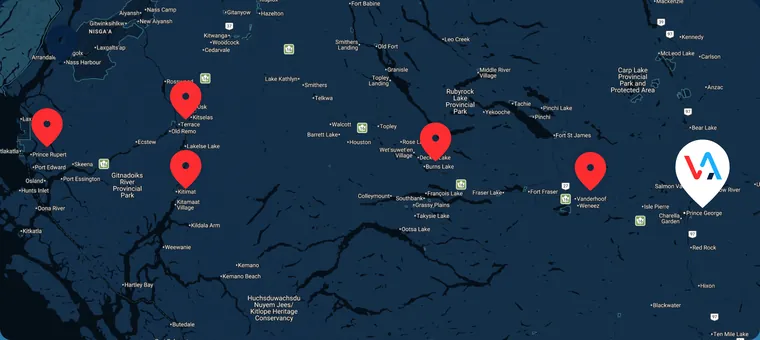
Additional Communities Served
Don't see your community listed? Reach out and we'll let you know if we can get to you.
Prince George, BC
Our home base. We test and verify gas pressure for residential and light commercial properties throughout the city.
Terrace, BC
Coastal northwest region. Pressure testing and diagnostics for homes of all ages and conditions, with special attention to coastal moisture and corrosion considerations.
Prince Rupert, BC
Northwest coastal community. Professional pressure diagnostics for complex and challenging installations, with documentation for code compliance.
Kitimat, BC
Mountainous terrain with varied construction. We test gas systems for residential properties and small commercial installations.
Burns Lake, BC
Highway 16 corridor between Prince George and the coast. Complete pressure testing and diagnostic services coordinated from our Prince George office.
Vanderhoof, BC
Central interior community. Professional pressure testing and diagnostics for residential and light commercial properties.

Specials & Coupons
Giving back to the community
We're proud to offer discounts to the people who serve our community.
First Responder & Senior Discount
A discount on service for active first responders and seniors.
Cannot be combined with any other offer.
Schedule Service
Customer Reviews
Read ReviewsSee What Our Prince George Neighbors Are Saying
We've built our reputation one job at a time across Prince George and the surrounding Northern BC communities. Read what real customers have to say about working with our team, and check out our current rating on Google.
Ready When You Are
Pressure Testing: Know Your System's True Health
Your gas system’s pressure is its report card. Too low, and appliances won’t work. Too high, and you risk leaks or damage. A slow drop means there’s a leak you can’t see. Professional pressure testing answers every question: Is my system leaking? Is my regulator failing? Is my new installation code-compliant? Is my repair really fixed? Elevated HVAC & Gasfitting brings precision equipment, certified protocols, and Technical Safety BC experience to every pressure test.
Pressure testing is the diagnostic foundation of responsible gas work. It’s what we do before we install a new gas line, it’s what we do after we repair a failing regulator or connection, and it’s what we recommend annually as part of a comprehensive gas safety check. For homeowners with gas appliances—furnaces, water heaters, fireplaces, or cooking equipment—knowing your gas system’s pressure is as important as knowing your home’s electrical panel is up to code.
Pressure testing is fast, affordable, and removes guesswork from gas system diagnosis. Whether you’re troubleshooting why a furnace isn’t igniting, verifying a water heater repair, or confirming a new installation, we’ll deliver the data and the clarity you need. Call us today to schedule your pressure test—we’ll test your system, document the results, and explain the findings in detail.
Family-Owned & Operated
Fortis BC Trade Ally Network
Journeyman Sheet Metal Worker
Certified Gas Contractor
15+ Years of Experience
Satisfaction guaranteed
